Is OpenClaw Right for Your Small Business? A Planning Guide
In January 2026, an open-source AI project called OpenClaw gained 163,000 GitHub stars in under a week, making it one of the fastest-growing repositories in the history of the platform. For most Australian small business owners, this number means nothing yet. But within two years, the idea behind OpenClaw, which is that every business should have a persistent AI agent running on its own infrastructure, monitoring its operations, and taking action on its behalf, will be as standard as having a website. This guide explains what OpenClaw is, why it matters for Australian SMBs specifically, and what an OpenClaw strategy for your business looks like in practical terms.
This is not a technical guide for developers. It is a business guide for owners who want to understand what this technology does, what it costs, and how to approach it without hiring a full-time technical team.
What OpenClaw Is, in Plain Business Terms
OpenClaw is an open-source AI agent framework. That phrase contains three words worth unpacking. "Open-source" means the underlying software is free to use and modify, and it is maintained by a global community of developers. "AI agent" means a software system that can take autonomous actions on your behalf, not just answer questions. "Framework" means it is a foundation you build on, not a finished product you install and run immediately.
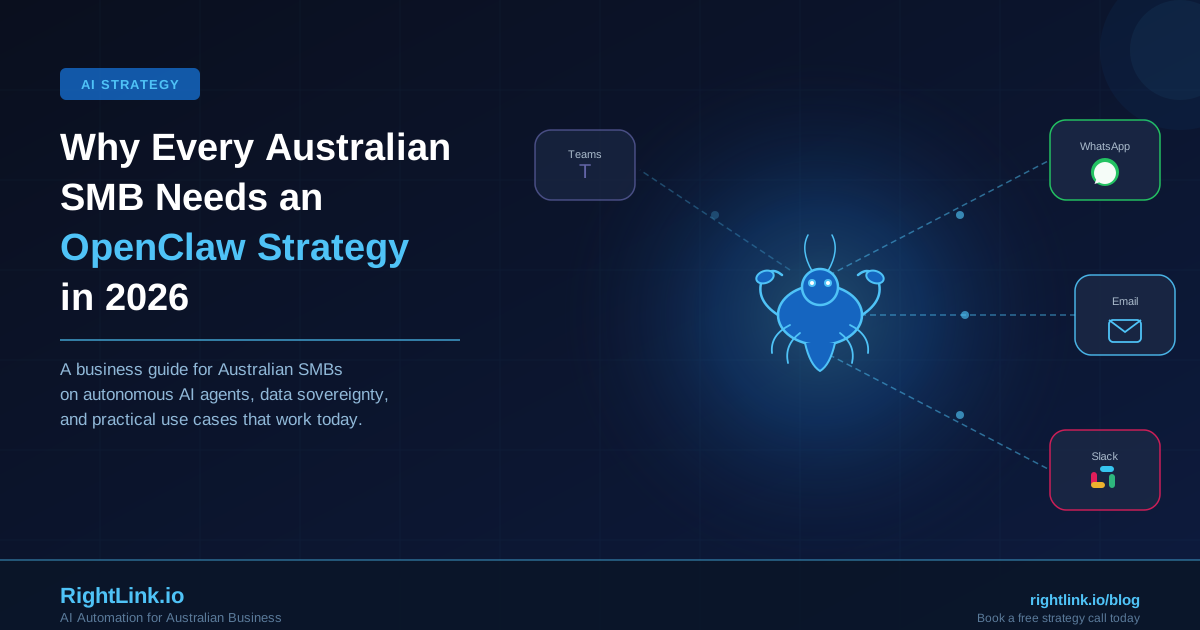
In practical terms, OpenClaw is a persistent AI assistant that runs on your own computer or server. It connects to the messaging apps your business already uses, including WhatsApp, Slack, email, and Teams. It wakes up on a schedule, checks a list of tasks you have defined, and either completes them automatically or sends you a message asking for your input on anything it cannot handle independently.
The key distinction between OpenClaw and tools like ChatGPT or Claude is persistence. ChatGPT answers questions when you ask them. OpenClaw monitors and acts continuously, without you initiating every interaction. Think of it less as a sophisticated search engine and more as a capable junior employee who is always at their desk, never calls in sick, and does not forget things between conversations.
Why OpenClaw Matters Specifically for Australian SMBs
OpenClaw's most significant advantage for Australian businesses is its data sovereignty model. All memory, context, and data is stored as plain text files on your own hardware. Nothing is sent to a third-party server unless you explicitly configure it to be. For Australian businesses operating under the Privacy Act and serving clients in regulated industries including healthcare, financial services, and government, this is a meaningful differentiator from cloud-based AI tools.
A Canberra-based consultancy serving Federal Government agencies, for example, can configure an OpenClaw agent using a local AI model from Ollama, ensuring that all project data, client communications, and knowledge base information stays within their own infrastructure. The same capability with a commercial AI platform would require an enterprise data residency agreement that most SMBs cannot access or afford.
Check current hosting, model and connected-service charges for the proposed setup. Usage limits, maintenance and monitoring can matter as much as the initial configuration cost.
Four Business Use Cases That Work Today
Morning Briefing and Inbox Triage
Configure your OpenClaw agent to wake up at 6:30am every business day, scan your email inbox for messages received overnight, identify anything flagged as urgent or containing a specific keyword (quote, invoice, urgent, complaint), and send you a WhatsApp summary before you arrive at the office or job site. The summary includes the sender, subject, and a one-sentence description of what action is required. You arrive knowing exactly what needs your attention before you have opened a single email.
Automated Follow-Up Reminders
Connect your agent to your CRM or job management system through an API. Configure a heartbeat task that checks, every morning, whether any quote sent more than 48 hours ago has not received a response. If it finds one, the agent sends you a WhatsApp message with the client name, quote amount, and a suggested follow-up message you can send with a single tap. This is not fully automated follow-up. It is automated monitoring with human approval for the outbound message. That distinction is important: it keeps you in control while eliminating the cognitive load of remembering to check.
Internal Knowledge Assistant
Upload your business documents, service manuals, pricing schedules, and compliance policies to the agent's knowledge base. Staff can then ask the agent questions via WhatsApp or Slack and receive accurate, sourced answers without interrupting you. A plumbing business, for example, might upload its pricing guide, warranty policies, and commonly asked FAQ responses. Apprentices and junior staff can get immediate answers to questions they would otherwise escalate to the business owner.
Competitor and Market Monitoring
Configure a heartbeat task that checks a list of competitor websites or Google Alerts keywords on a weekly schedule and sends you a summary of any significant changes or news. A hospitality business monitoring competitor menu changes, a professional services firm tracking industry news, or a trades business watching for changes in local council requirements can all benefit from automated monitoring that currently requires someone to do it manually.
What an OpenClaw Strategy Looks Like for a Small Business
An OpenClaw strategy is not about deploying the most sophisticated AI agent possible on day one. It is about defining the three to five monitoring and administrative tasks that currently consume the most cognitive overhead in your business and configuring the agent to handle those tasks reliably before adding anything else.
The strategy has four components. First, define the agent's scope: what will it monitor, what will it act on autonomously, and what will it bring to you for a decision? Clear scope prevents the agent from either doing too much (creating errors on real client interactions) or too little (running without producing useful output).
Second, define the heartbeat checklist: the list of tasks the agent runs on its schedule. This is the most important configuration document in the entire setup. A well-written heartbeat checklist turns the agent from a novelty into a reliable operational tool.
Third, define the escalation rules: the specific conditions under which the agent must contact you immediately rather than waiting for the next scheduled check. An overdue invoice from your largest client, a complaint message using specific language, or a booking conflict that cannot be resolved automatically all warrant immediate escalation.
Fourth, define the knowledge base: the documents and information the agent needs to answer questions accurately. The quality of the knowledge base determines the quality of the answers. Spend time on this and the agent becomes a genuinely useful knowledge resource. Skip it and the agent gives generic responses that are no more useful than a Google search.
Plan for testing and refinement
Start with a narrow, read-only task and controlled examples. Record what the agent should notice, what it should ignore and when it should alert a person. Review missed or unnecessary alerts before expanding its scope.
RightLink is a new automation business. This guide describes a planning approach, not a claim of established client deployments. Ask for a demonstration of the proposed workflow and confirm current product capabilities before committing.
Common Mistakes Businesses Make When Approaching OpenClaw
The first mistake is treating OpenClaw as a consumer product that can be installed and used immediately without configuration. Unlike ChatGPT or Claude, OpenClaw requires meaningful setup before it delivers business value. Budget for a setup phase of two to four hours of configuration work before the agent is operational, and a refinement phase of two to four weeks before it is reliable.
The second mistake is giving the agent write access to external systems before it has been thoroughly tested with read-only access. An agent that can send emails or post to your CRM on your behalf without proper guardrails will eventually do something you did not intend. Start with monitoring and alerting. Add action capabilities only after you are confident in the agent's judgement on the tasks you have defined.
The third mistake is not documenting what the agent is supposed to do. If the configuration is entirely in the agent's instruction files and nobody on your team understands what it is monitoring and why, you will not be able to troubleshoot it when something unexpected happens. Maintain a simple one-page document that describes the agent's scope, heartbeat tasks, escalation rules, and knowledge base sources.
Which monitoring or administrative task in your business is consuming the most cognitive overhead right now? That is almost certainly where your OpenClaw strategy should start.
RightLink helps Australian businesses design, configure, and operate OpenClaw agents for real business use cases. Learn about our AI strategy and implementation services or book a free consultation to discuss your OpenClaw strategy.
Find your first practical automation
Bring us the process that takes too much time or leaves enquiries waiting. We will map it with you and discuss a sensible first step. Book a Free Consultation—30 minutes, no obligation. Send your details, then choose a time.