What Is a 90-Day AI Pilot Plan? A Template for Australian SMBs
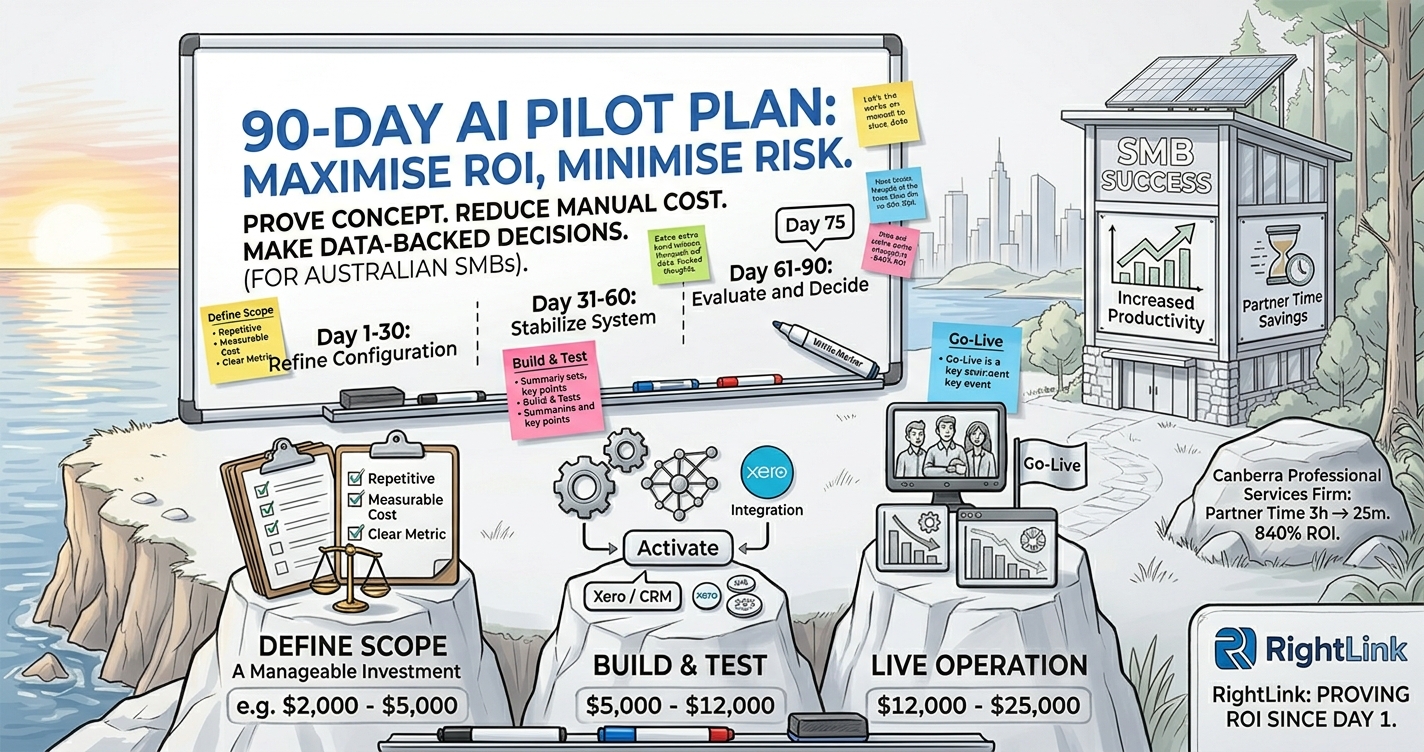
The most expensive AI automation mistake an Australian small business can make is committing to a large, multi-process implementation before proving the concept on a single, well-scoped workflow. A 90-day AI pilot plan protects your budget, accelerates your learning, and gives you the evidence you need to expand the automation programme with confidence. This guide gives you a practical template you can use immediately, regardless of your industry or current tech stack.
A pilot is not a trial. A trial is passive. A pilot is active: you define what success looks like before you start, you measure it rigorously during the 90 days, and you make a deliberate decision about what comes next at the end. That structure is what separates businesses that build sustainable automation programmes from those that spend money on tools they never fully use.
Why 90 Days Is the Right Time Frame
Each phase of the 90 days serves a distinct purpose:
- Day 1 to 30: Configuration is still being refined, edge cases are being resolved, and your team is adapting. The numbers from week two are not representative of steady-state performance.
- Day 31 to 60: The system has stabilised. You now have reliable, comparable performance data.
- Day 61 to 90: Enough evidence exists to make a confident, data-backed decision about what comes next.
Thirty days is too short to get clean data. Six months is too long and costs you both momentum and revenue you could have been recovering sooner. Ninety days hits the right balance.
Week 1 to 2: Define the Pilot Scope
The best first automation is not the most ambitious one. Choose a process that meets all three of the following criteria:
- Repetitive and predictable: The same steps happen the same way every time, with minimal variation.
- Measurable cost: You can put a specific number on what the manual version costs in time or money each week.
- Clear success metric: You will know definitively whether the automation is working or not.
For most Australian SMBs, strong first pilots include:
- Automated quote follow-up for a trades business
- Appointment reminder and confirmation for a health practice
- After-hours lead capture for a hospitality or retail business
- Weekly financial summary reporting for any business owner compiling numbers manually
Before you build anything, write a one-page pilot brief covering the process being automated, the baseline cost, the success metric, and the 90-day target.
Week 3 to 4: Build and Test
The build phase should take no longer than two weeks for a well-scoped automation. If it is taking longer, the scope is too broad. Reduce the scope rather than extending the timeline.
Before go-live, run the automated process in parallel with the manual process for three to five days. This is not optional. Parallel running reveals edge cases that did not appear during configuration:
- The client who always spells their name differently
- The job type that does not fit the standard template
- The message that triggers the wrong workflow
Also confirm that all integration points are working correctly. If the automation connects to Xero, ServiceM8, or your CRM, verify data is flowing in both directions before you switch off the manual process entirely.
Week 5 to 8: Live Operation and Monitoring
Assign one person in your team to be the automation owner for the pilot period. Their weekly responsibilities are:
- Review the exception log (interactions the automation could not handle automatically)
- Flag any recurring patterns that suggest the configuration needs adjustment
- Document what is working and what is not
In most pilots, the first two weeks of live operation produce a handful of unanticipated edge cases. This is normal. The goal is not zero exceptions. It is a steadily declining exception rate as the configuration improves and the team adapts.
Check your pilot success metric at the end of week 8. If you are behind target, identify the specific exception type causing the shortfall and address it before the final evaluation.
Week 9 to 12: Evaluate and Decide
The 90-day evaluation is a formal review. Pull the data from your automation platform, compare it to your week-one baseline, and calculate actual ROI against the formula in your pilot brief.
The evaluation produces one of three outcomes:
- Expand: The automation met or exceeded its target. Scope the next highest-value process and repeat.
- Optimise: The automation is working but fell short due to a specific, fixable configuration issue. Address it and extend the pilot by 30 days before deciding.
- Stop: The process was not suitable for automation at this stage. Document why, apply the learning to your next pilot selection, and choose a different starting point.
Most first pilots fall into the expand category when the scope was correctly defined.
Illustrative pilot: collecting onboarding documents
A professional services business could pilot a workflow that requests an agreed document list, tracks what has arrived and alerts the responsible person when information is missing. It should avoid sending repeated requests after a document has been received.
This is a planning example, not a completed client project. Measure time spent chasing documents, complete handovers and errors before and during the pilot. Keep a person responsible for deciding whether the record is complete.
Common Mistakes in the First 90 Days
- Defining success as "the automation is running" rather than "the automation is delivering a measurable outcome." Running and delivering are different things.
- Not communicating the pilot to the team before go-live. A five-minute briefing covering what the automation does, what it does not do, and how to flag exceptions is all that is required.
- Changing too many things at once. Do not simultaneously change your pricing, onboard new staff, and launch a new service line during the pilot. You need to be able to attribute outcomes specifically to the automation.
What is the one process in your business that, if automated, would free up the most time in the next 90 days?
RightLink designs and builds automation pilots for Australian SMBs with a clear ROI framework from day one. Learn about our AI strategy services or book a free consultation to design your first pilot together.
Find your first practical automation
Bring us the process that takes too much time or leaves enquiries waiting. We will map it with you and discuss a sensible first step. Book a Free Consultation—30 minutes, no obligation. Send your details, then choose a time.