How to Implement AI in Small Business Australia: A Practical Guide
Most Australian Small Businesses Know AI Could Help. Few Know Where to Start.
You have heard the headlines. AI is transforming business. Automation is the future. But when you are running a plumbing company, a hair salon, or a small accounting practice, those headlines do not tell you what to do on Monday morning.
For a small business, the useful question is which repeated task is worth improving. Start with a specific process and the tools you already use rather than choosing AI for its own sake.
This guide will walk you through a practical, low risk approach to AI automation for small business Australia. No jargon, no hype. Just a clear process you can follow to identify your best opportunities, choose the right tools, and launch your first automation with confidence.
What AI Automation Actually Means for a Local Service Business
AI automation is not about robots replacing your team. For most small businesses, it means using software to handle repetitive, time consuming tasks that currently eat into your day: scheduling appointments, sending follow up emails, generating quotes, chasing invoices, or answering common customer questions.
Think of it as giving your business a digital assistant that works around the clock. A tradie can have quotes generated automatically based on job type. A salon can send booking reminders without anyone picking up the phone. An accounting firm can have client intake forms summarised in seconds instead of hours.
The businesses seeing the strongest results are not doing anything exotic. They are automating the small, annoying tasks that add up to hours of lost productivity every week.
Australian SMBs are well positioned to benefit here. Our service economy is built on local relationships and responsiveness. AI automation does not replace that personal touch. It frees you up to spend more time on it by removing the admin burden that keeps you stuck at a desk instead of serving customers.
Step 1: Audit Your Business for Automation Opportunities
Before you look at any tools, spend 30 minutes mapping out where your time actually goes. The goal is to find tasks that are repetitive, rule based, and high volume.
Ask yourself and your team these questions:
- Which tasks do we do every day that follow the same steps each time?
- Where do things fall through the cracks (missed follow ups, late invoices, forgotten bookings)?
- What admin work keeps us away from serving customers?
- Which processes involve copying information between systems?
Common high value automation targets for Australian service businesses include: appointment scheduling and reminders, quote generation and follow up, invoice creation and payment chasing, customer enquiry responses, social media content scheduling, and data entry between your CRM, accounting, and booking systems.
Rank your list by two factors: how much time the task consumes each week, and how much revenue or customer satisfaction you lose when it is done late or not at all. Start with the task that scores highest on both.
Step 2: Choose the Right AI Tools and Partners
Once you know what you want to automate, you have two broad paths: off the shelf AI tools or a specialist partner who builds and integrates automation for you.
Off the Shelf AI Tools
Off-the-shelf tools can support invoice reminders, lead follow-up and routine customer questions. Compare current vendor pricing, integration limits and usage charges before choosing a subscription.
The key is choosing tools that integrate with what you already use. You should not need to rip out your current systems. Look for platforms with pre built integrations to your existing booking, accounting, and communication tools.
Specialist AI Partners
If your needs are more specific, or you want a connected system rather than individual point solutions, an AI strategy consultant (rightlink.io/ai-strategy) can help you design an automation roadmap tailored to your business. This is especially valuable when you need to connect multiple systems, when off the shelf tools do not fit your workflow, or when you want to ensure you are investing in the right areas first.
Step 3: Start Small with a Low Risk Pilot
This is where most small businesses either succeed or stall. The temptation is to automate everything at once. Resist it.
Pick one workflow. Set a clear success metric (hours saved per week, response time reduced, follow up rate improved). Give it 30 days. Measure the result.
A good pilot has three characteristics:
- Low stakes: If something goes wrong, it is easy to fix and does not damage customer relationships.
- High frequency: The task happens often enough that you will see results quickly.
- Measurable: You can compare a clear before and after metric.
For example, if you are a trades business, automating your quote follow up emails is an excellent first pilot. The process is repetitive, the volume is high, and you can measure the conversion rate before and after within a few weeks.
Step 4: Train Your Team and Manage the Change
AI tools are only as effective as the people using them. Even the best automation will fail if your team does not understand it, trust it, or know how to step in when something needs a human touch.
Keep training practical. Show your team what the tool does, how it saves them time, and what they need to monitor. Most small business AI tools require minimal technical skill. The bigger challenge is usually mindset: helping your team see automation as support, not a threat.
A useful approach is to involve your team in the pilot from day one. Ask them which tasks they find most tedious. Let them see the automation in action before it goes live. When staff feel ownership over the change rather than having it imposed on them, adoption rates improve significantly.
For ongoing capability building, consider starting with foundational AI literacy before moving into hands on tool training. If you want a structured approach, AI education programmes (rightlink.io/education) designed for non technical business users can take your staff from foundational literacy to confidently managing AI powered workflows.
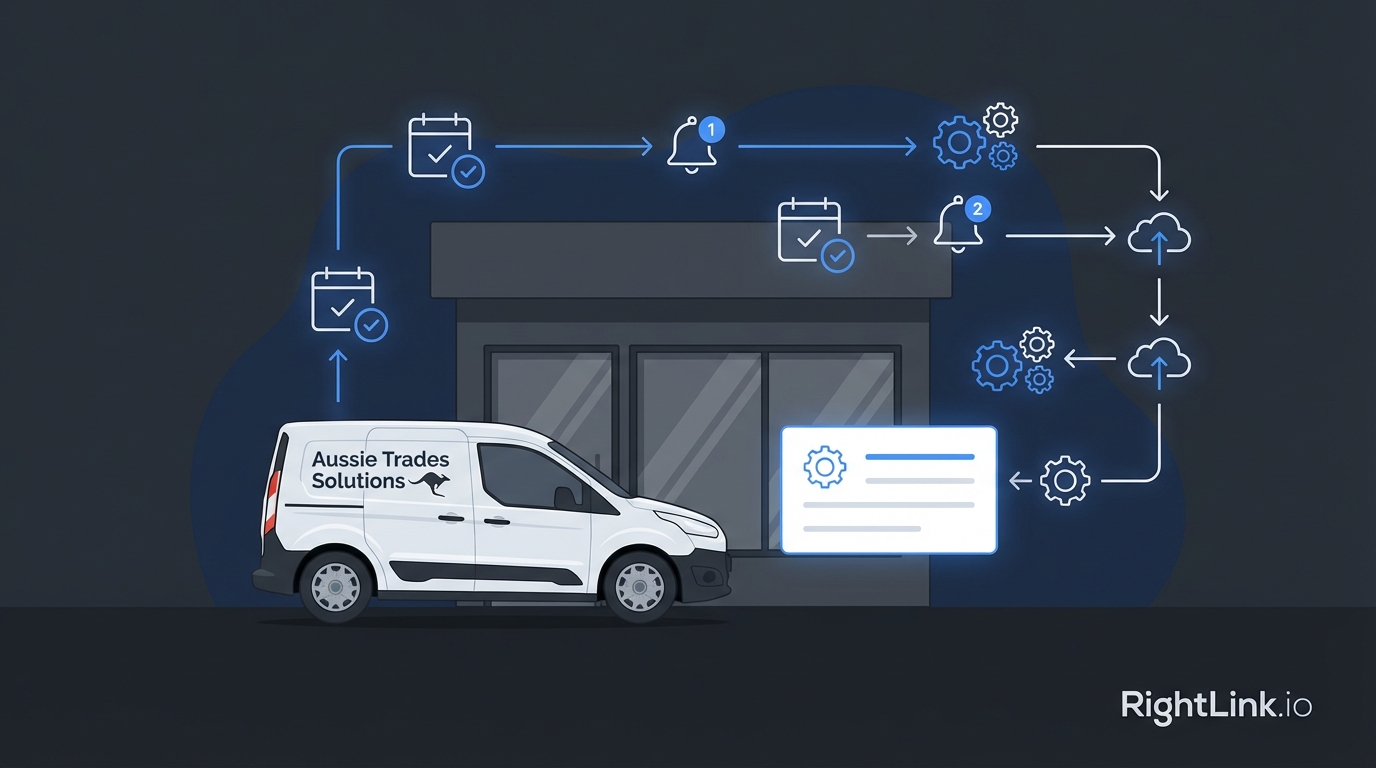
Illustrative workflow: following up a trades enquiry
This is a hypothetical workflow, not a RightLink client result. A trades business could connect its enquiry form to a shared job queue, send an approved acknowledgement and assign a callback task. After a quote is sent, the team could use a follow-up reminder to check whether the customer needs more information.
Test with controlled enquiries first. Compare response time, quotes and won jobs against a baseline, and include the time spent correcting exceptions. Agree customer communication preferences before sending automated messages.
Common Mistakes to Avoid
After working with Australian small businesses exploring AI automation, several patterns emerge in what goes wrong.
- Trying to automate everything at once. Businesses that attempt a full digital transformation in one go almost always stall. Start with one workflow, prove the value, then expand. Momentum matters more than scope.
- Choosing tools before defining the problem. It is tempting to sign up for the latest AI platform because a competitor mentioned it. But if you have not mapped your actual pain points, you will end up paying for features you do not use.
- Ignoring the human element. Automation handles the repetitive work, but your customers still expect a human when things get complex. Design your workflows with clear handoff points where a real person steps in.
- Not measuring the impact. Research shows that most Australian SMBs using AI do not have a structured way to measure whether it is working. Set a baseline metric before you start, and check it monthly. If you cannot measure it, you cannot improve it.
- Overlooking available support. The federal government has funded AI Adopt Centres offering free training and one on one advice for SMEs. State programmes and the R&D Tax Incentive may also apply to your AI projects. Talk to your accountant about what might be available.
Australian Programs and Funding Worth Exploring
You do not have to figure this out alone. Several government and industry programs exist specifically to help Australian small businesses adopt AI safely and effectively:
- AI Adopt Centres: Federally funded centres providing free AI training, advisory, and implementation guidance for SMEs.
- State digital capability programs: Various state governments offer grants and support for small businesses investing in digital tools, including AI automation.
- R&D Tax Incentive: If your AI implementation involves developing new processes or integrations, you may qualify for a tax offset. Your accountant or tax adviser can assess eligibility.
These are not just grants. Think of them as support pathways: free expert access, structured training, and financial incentives that can significantly reduce your upfront investment.
Frequently Asked Questions
How much does AI automation cost for a small business?
Costs depend on the workflow, integrations, usage and support. Ask for a written breakdown of implementation, software subscriptions and any usage charges. RightLink scopes each project after a free consultation; there is no standard return or payback period we can promise.
Do I need to be technical to use AI tools?
No. The majority of AI tools designed for small businesses require no coding or technical background. If you can use email and a smartphone, you can use most modern AI automation platforms. Where things get more complex (connecting multiple systems or building custom workflows), a specialist partner can handle the technical work for you.
Will AI replace my staff?
For small businesses, AI automation is about enhancing your team, not replacing them. The goal is to remove repetitive admin so your people can focus on higher value work: serving customers, building relationships, and growing the business.
Ready to Take the First Step?
Implementing AI automation in your small business does not require a massive budget, a technical background, or a complete overhaul of your systems. It starts with one process, one tool, and one measurable goal.
Which process in your business would you automate first? We would love to hear your thoughts.
Ready to take the next step? Book a free consultation (rightlink.io/contact) with our team to identify your best automation opportunities (rightlink.io/automation) and build a practical roadmap tailored to your business.
Find your first practical automation
Bring us the process that takes too much time or leaves enquiries waiting. We will map it with you and discuss a sensible first step. Book a Free Consultation—30 minutes, no obligation. Send your details, then choose a time.