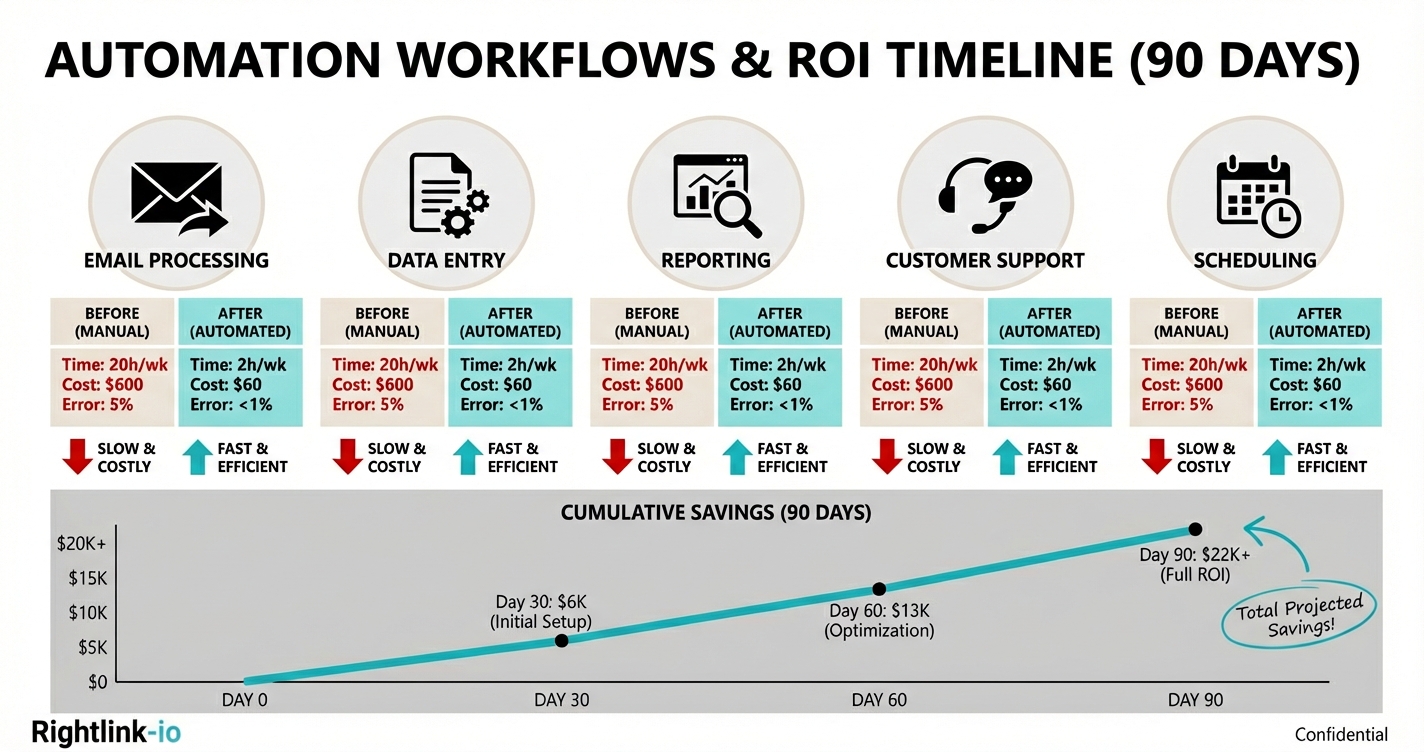
5 AI Workflow Automations That Paid for Themselves in 90 Days

According to Gartner, 80% of businesses implementing AI automation fail to see positive ROI within the first year. The reason? They automate the wrong things. Yet companies that take a strategic, ROI focused approach to workflow automation are seeing payback periods of 90 days or less. The difference isn't the technology; it's knowing which processes to automate first and how to measure success from day one.
In this post, you'll discover five specific workflow automations that paid for themselves in under 90 days. You'll see the exact processes these businesses automated, the tools they used, and the measurable results they achieved. By the end, you'll have a clear framework for identifying your own quick win automation opportunities and a proven methodology for tracking ROI from implementation through payback. These aren't theoretical possibilities. They're documented results from real businesses that chose to automate strategically.
The Challenge: Most businesses approach AI automation backwards. They invest in enterprise platforms, spend months on implementation, and struggle to quantify the actual business impact. According to McKinsey's 2024 AI Report, the average automation project takes 6 to 8 months to show positive ROI, with 45% of initiatives abandoned before completion due to unclear value delivery.
This leaves finance teams hesitant to approve automation budgets, operations managers frustrated with slow progress, and IT departments overwhelmed with complex integrations. What makes it worse? While you're debating whether automation is "worth it," your competitors are already seeing returns. The manual processes you're tolerating today aren't just inefficient. They're costing you thousands in labor hours, error corrections, and missed opportunities every single month.
Without strategic automation, you're losing more than just productivity. Every manual invoice entry, customer onboarding sequence, and data transfer between systems represents wasted salary dollars that could be redirected to growth activities. At current rates, that's potentially $50,000 to $150,000 annually for a mid sized team. Whilst your competitors automate high volume, repetitive tasks and reinvest those savings into customer acquisition, you're stuck maintaining the status quo. The opportunity cost isn't just financial. It's strategic positioning in an increasingly automated marketplace.
Automation #1 (Invoice Processing & Approval)
Cut Invoice Processing Time by 87% and Eliminate Data Entry Errors
Instead of manually reviewing vendor invoices, matching purchase orders, and routing for approval (a process taking 15 to 20 minutes per invoice), intelligent document processing automates the entire workflow. For a company processing 200 invoices monthly, this approach saves 60 hours of admin time each month.
A mid sized manufacturing company implemented this automation using a combination of optical character recognition (OCR) and workflow automation tools. The system automatically extracts data from incoming invoices (regardless of format), matches against purchase orders in their ERP system, routes to appropriate approvers based on amount and department, flags discrepancies for human review, and processes payment once approved.
The Result: Processing time dropped from 15 minutes to 2 minutes per invoice. Data entry errors fell to zero. The finance team redirected 60 hours monthly toward strategic analysis. Total implementation cost: $4,200. Monthly savings in labor costs: $3,600. Payback period: 35 days.
The key was starting with a high volume, rules based process where errors had measurable consequences.
Automation #2 (Customer Onboarding Sequences)
Transform Customer Onboarding From 6 Hours to 20 Minutes
A B2B SaaS company was spending 6 hours per new customer on onboarding, including sending welcome emails, creating accounts, scheduling training, and configuring initial settings. With 30 new customers monthly, that's 180 hours of repetitive work.
They implemented an automated onboarding workflow that triggers when a deal closes in their CRM. The workflow includes welcome email sequences sent automatically with personalized login details, training sessions scheduled based on customer timezone, product accounts created and configured with company specific settings, internal team notifications sent to customer success managers, and 30 day check in reminders scheduled automatically.
The Result: Onboarding time reduced to 20 minutes of verification and customization. Customer time to value improved by 40% as onboarding now happens immediately rather than waiting for the next business day. Monthly time savings: 165 hours. Implementation cost: $2,800. Monthly value: $9,900 in redirected customer success capacity. Payback period: 8 days.
This worked because onboarding was sequential, repeatable, and had clear trigger events that made automation straightforward.
Automation #3 (Lead Qualification & Routing)
Score, Qualify, and Route Leads in Real Time Without Manual Review
A professional services firm was manually reviewing 400+ leads monthly to determine which were sales qualified. Their process involved checking company size, budget indicators, and engagement history, taking 10 to 15 minutes per lead. High value leads often waited 24 to 48 hours for follow up while being reviewed.
Their automated lead scoring system now enriches incoming leads with company data (size, revenue, industry), scores leads based on 12 qualification criteria, routes hot leads to appropriate sales reps within 5 minutes, nurtures cold leads through automated email sequences, and updates CRM records with qualification status.
The Result: Sales team now focuses only on qualified opportunities. Response time for hot leads dropped from 36 hours to 5 minutes, resulting in 34% higher conversion rates. 100+ hours monthly saved in lead review. Implementation cost: $3,500. Monthly value from time savings plus increased conversions: $18,000. Payback period: 6 days.
The ROI multiplier here wasn't just efficiency. It was the revenue impact of faster response times converting more qualified leads.
Case Study: Regional Healthcare Provider Automates Patient Follow Up
The Challenge: A regional healthcare network with 8 clinics was struggling with post appointment follow up. Patients needed medication reminders, appointment scheduling, satisfaction surveys, and insurance verification, but staff could only reach 60% of patients due to time constraints. This resulted in missed appointments (costing $150 per no show), lower patient satisfaction scores, and compliance concerns. The manual calling process consumed 35 staff hours weekly across all locations.
The Solution: They implemented a multi channel patient engagement automation that triggered based on appointment status. The system sends SMS reminders 48 hours and 2 hours before appointments, automated satisfaction surveys 24 hours post visit, medication reminders scheduled based on prescription data, insurance verification requests sent prior to next scheduled visit, and escalates failed contact attempts to staff for phone follow up.
The system integrated with their existing practice management software and required minimal training. Implementation took 3 weeks from decision to full deployment.
The Result: Within 90 days, the network saw no show rates drop from 18% to 7% (saving $126,000 annually in lost appointment revenue), patient satisfaction scores increase 23 points, staff follow up time reduced from 35 hours to 8 hours weekly, and 92% of patients now reached with appropriate follow up.
Financial Impact: Implementation cost: $8,500. Monthly labor savings: $6,480. Monthly revenue recovery from reduced no shows: $10,500. Total payback period: 15 days.
The key success factor was choosing a problem with measurable business impact (no show costs) and clear ROI metrics from day one.
Quick Wins
Getting Started: Your 90 Day Automation Roadmap
- Week 1 to 2: Process Audit Map your top 10 most time consuming repetitive tasks. Track time spent, error rates, and business impact for each. Prioritize processes that are high volume (100+ occurrences monthly), rules based, and have measurable costs when done incorrectly.
- Week 3 to 4: ROI Analysis For your top 3 processes, calculate current costs (labor hours × hourly rate + error costs). Research automation tools and get implementation quotes. Build business case showing payback timeline.
- Week 5 to 6: Pilot Implementation Start with ONE automation: your highest ROI opportunity. Implement in controlled environment. Document before and after metrics meticulously.
- Week 7 to 10: Measure & Optimize Track daily metrics including time saved, errors eliminated, and cost reduction. Adjust workflows based on user feedback. Calculate actual ROI.
- Week 11 to 12: Scale Success Once first automation proves ROI, apply learnings to next priority process. Build internal momentum with documented wins.
Pro Tip: Don't try to automate everything at once. Serial implementation of high impact automations builds confidence, proves value, and creates internal advocates for future projects.
Common Concern: "We're too small for automation. It's only worth it for enterprise companies."
Reality: The businesses in these case studies ranged from 15 to 200 employees. Modern automation tools are priced for businesses of all sizes, with many offering free tiers or pay as you go models. A company processing 200 invoices monthly saves $43,200 annually, regardless of company size. The ROI math works at any scale when you automate the right processes.
Common Concern: "Our processes are too unique to automate."
Reality: 80% of business processes follow repeatable patterns, even if they feel custom. The healthcare provider thought their patient follow up was "too personalized" to automate, yet still achieved 92% patient reach with automated communications. The key is identifying the structured, repeatable elements within your "unique" workflows and automating those while keeping human touchpoints where they add genuine value.
Ready to identify your 90 day ROI automation opportunities? Get your free Automation ROI Assessment, a personalised 30-minute consultation where we'll review your highest volume repetitive processes, calculate potential time and cost savings, identify your top 3 quick win automation opportunities, and provide estimated payback timelines for each.
No commitments, no sales pressure. Just data driven insights into where automation can deliver the fastest returns for your business.
[Schedule Your Free ROI Assessment]
The businesses featured here didn't have unlimited budgets or massive IT teams. They simply chose to automate strategically, starting with high impact processes and measuring results rigorously. Your 90 day payback automation is waiting. You just need to identify it and take action.